31.3.07

The "G" Word

If you’ve been following the news or reading my modest edification on the Balkans, then you’ve probably been retaining a lot of numbers and figures by now. Including the most recent figures, after 15 years of peacekeeping, the remaining British troops have left Srpska, as part of a withdrawal plan in which some 600 of ‘em were phased out of the country. (The British contingent was part of the EUFOR, a security body in place after the war, following NATO’s mission.)

But as a whole, most numbers relayed in relation to Balkan history is a human matter.

After the World Court hearing in March, in which genocide was declared in part on Serbs collaboration in exterminating 8,000 Bosnian Muslims at Srebrenica; a number of other “numbers” have surfaced to be taken up in court.

Sierra Leone: Tens of thousands
Rwanda: Estimated 500,000
Darfur: Estimated at 30 -70,000 people.

These figures are related to estimated deaths as a result of genocide, which if factoring other causes for death, i.e. war, famine, disease; the number of fatalities is significantly greater. In dealing with genocide crimes, there must be evidence and proof of intent to destroy a population. For example, Milosevic was not found guilty of genocidal crimes in the Samura whose work on the diamond trade in West Africa evoked the Hollywood blockbuster “Blood Diamond,” said in an interview that anything deemed valuable on the continent is a curse. That is to qualify not just the bloody trade of diamonds, but also blood gemstones (Madagascar); blood coffee (Kenya); and blood oil (Nigeria), for example.

Economists call this “the resource curse,” a reference to countries with great natural wealth that fail to diversify their industry or invest in education, which leads to long-term economic decline.

Genocide is not an isolated event that occurs in Africa based on its own discordant history and culture. This train of thought is warped in racist imperialism in which the Western powers have no impunity in their involvement of orchestrating developing regions. One can chronologically trace how banana republics and straw men cum dictators are raised by Western Powers—i.e. Chile, Nicaragua, Iraq, Liberia, and so on.

To extrapolate this Western hand or the consumer dollar in Africa’s nightmares, for example, perpetuates the adage of the “dark continent.” This wholly outdated premise of approaching the nether world, as less than, in which developing societies are not understood to be fighting “civilly” (as if war was civil), for any real reason, but gain public attention from Amnesty International or Bono, provided the sheer amount of barbaric imagery on hand. The very hesitation to intervene in such intensified places that the West has set up is barbaric.

But this is after all, the United States’ legacy to play ref, come Arkansas, Texas or holy high waters. The US' obstinate foreign policy that determines where to intervene and when to cry foul is entirely exempt from international protocol. And that perhaps is the constant theme in US history: a refusal to acknowledge the world at large.


Even now, perhaps in admonition of being indicted for war crimes, the US the US refuses to join the International Tribunal for War Crimes.

Bypassing international protocol for UN anything altogether, this is one of many instances in which genocide is used as a means for intervening and thus deploring other parts of the world, which are consistently, economically disadvantaged.

In Brendan O’Neill’s “Pimp My Genocide,” he writes that the G-Word is prostituting Third World to justify whatever means needed to assert power and moral authority. He writes, ‘…genocide’ becomes the language of international relations, effectively a bargaining chip between states, then it can lead to a grisly competition over who is the biggest victim of genocide and who thus most deserves the pity and patronage of the international community.”

Thus Israel calls genocide on Palestine; Milosevic called genocide on NATO; and the Bosnian Serbs can cry foul on Bosniaks. In a sense we have made genocide competitive.

And now, the most recent number:
Turkey: 1,000,000 Armenians


France passed a bill last year declaring it illegal to deny the Armenian genocide. A historical date that began in 1915, in which a million plus Armenians were slaughtered by Turks. This bill placates Armenian immigrant-voters in France and was also used as a means to chastise Turkey and block their entry into the European Union.

And guess who gets to "diplomatically" clean up the interplay at hand? Therefore having to deny the genocide in part? Turkey's friend, the USA. ..

Is there any place in this shrinking world where the US can be isolated, exempt, entirely uninvolved?

13.3.07

The Hague-- not a popular Spring Break destination


Now that Serbia has stepped down from the defense side of the World Court hearing on genocide in Bosnia, Serbia has not left the building.

Rising to the defense just in March, stands Kosovo's former Prime Minister, who resigned after his indictment for war crimes committed against Serbs during the 1998-99 war.

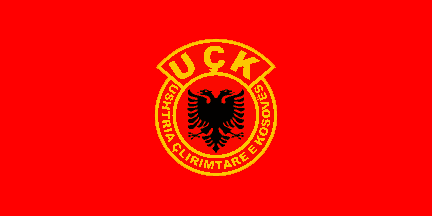
Ramush Haradinaj, was the commander general of the Kosovo Liberation Army, serving the majority of ethnic Albanians that make up the region. The KLA is historically the strongest paramilitary unit in the world. Why? Because it popped up overnight and successfully overwrought Serb and Yugoslavian occupation (with the assistance of NATO.)

Considering the precarious nature of Kosovo's impending sovereignty, it is unlikely that a verdict will be reached in Haradinaj's case, until later in the year, provided this state establishes stability.

Kosovo is the heartland for Serbs, and in one's hearts, it will forever be. During the Serbian rule from 1990-96 under Milosevic, Kosovo became a police-state. In a population makeup of percent ethnic Albanian-to-less than 20 percent, Serbian, the state tightly controlled all institutions in an apartheid-designed governance.

*Interesting side-note, as part of Milosevic's plan to beef up Kosovo and keep Serb refugees out of Serbia, he sent Croatian and Bosnian Serb refugees from the war to Kosovo. This way, it would fill the Serbian population that was notwithstanding the ethnic Albanian majority. All refugees seeking university, were also forced to attend the one university in Kosovo.

This denial of job and education opportunities, not to mention the distinction of cultures, including religion and language, created the growing insurgency. After the 1999 NATO airstrikes, Serbia was defeated. Close to a million ethnic Albanians who fled as refugees, returned over time. While as a result, some 250,000 Serb refugees fled. Not what the UN or NATO had hoped for. Casualties are still being speculated as mass graves are unturned. It is estimated that 10,000 ethnic Albanians were killed. Some 1,000 Serbs and Romany were also killed. Less than ten percent of the population in Kosovo today is Serbian. Currently, around here, there are fundraisers to give blankets and supplies to those remaining Serbs in Kosovo, whose existence still is precarious at best. The United Nations has administered an interim government thereafter and continues to in these final days before relinquishing it to the ethnic Albanians.

Despite knowing that Kosovo will in fact become an independent state, Serbs and possibly the state of Serbia, will refuse to recognise it as such. The current president of Serbia, a Democrat, has presented himself as a liberal, including issuing a public apology to Bosnia for the verdict on Srebrenica, a precedent in their history, but his parliament and nationalist Prime Minister are divided on Kosovo, which is a very dicey topic to bring up in any classroom, bar or street round here...


2.3.07

Unsettling the Score

As neighbors settle matters in court, so do countries. Namely, Bosnia, on behalf of the uncountable number of people killed during the '92-95 war, took their Eastern neighbor and former occupier, Serbia, to The Hague, on the grounds of genocide. In a historical case for the World Court, the United Nation's highest court, decided after years of waiting for trial and months in deliberations, to exempt Serbia for genocide, 13-2, however the court ruled that Serbia failed to prevent genocide where Srebrenica* is concerned.

*The massacre of Srebrenica involved the deliberate execution of 8,000 Muslim men by Bosnian Serbs. This is the largest mass murder in Europe since World War II. For the record, the massacre also resulted in the systematic rape of tens of thousands of Muslim women. The state of Serbia, which once housed Milosevic and his regime, funded and assisted the Bosnian Serbs in this massacre that is located in the eastern region of Bosnia, an ethnic enclave of Bosniaks, (which denotes, Muslim). This strategic area that lies on the border of Serbia would compromise the boundary and border for the creation of Srpska, the state carved out for Bosnian Serbs. On those grounds, ethnic cleansing was the campaign waged by the army of the Republika Srpska and a paramilitary unit from Serbia, called "The Scorpions."


This controversial case is major in its precedents and ramifications.
  • For starts, this is the first time the ICJ or World Court has ruled over states. (Normally it handles matters of sovereignty and diplomatic relations).
  • It is also unprecedented for one state to sue another, i.e. "The Federation of Bosnia-Hercegovina V. The People's Kingdom of Serbia"
  • Furthermore, it is the first for a state to sue another state over genocide.
  • To prove genocide is not as easy as pointing to mass graves and hearing widows and survivor stories as with the noble Truth and Reconciliation Act in South Africa. And in this case, it is complicated by semantics and convention codes on what is definitively genocide and intent of genocide, not to mention the rather ambivalent twin, "ethnic cleansing." Both of which involve the deliberate commitment to "destroy in whole or in part, a national, ethnic, racial or religious group" (Geneva Convention, 1948).

What Bosnia sought out was the recognition of human ambush and the compensation for it, as to this day, some 16 years after the fact, no formal reconciliations or apologies have been exchanged. An estimated $60 billion was the asking price, a price Serbia cannot credit to its inflated dinar-000 unit economy.

What Serbia got at the end of the day, is redemption. Bosnia, in as much as it has moved on, suffers a blow from this. While Srebrenica goes acknowledged and has been from films to survivor stories broadcasted on a global scale, there remains these figures that are hard to swallow. As the result of the war, an estimated two million people were displaced, some 300,000 were killed, countless raped, tortured harassed and damaged. One development on the legal front, is that gender-based war crimes has reached the UN Courts, albeit the jurisdiction goes into effect, for cases after July 1.

In some respects, this case exonerates Serb consciousness from the public eye (except their pal, Putin et co. have always been comrades). But this historical event is not over. The Hague still has other guests invited for a visit to the people's court or International War Crimes Tribunal, where Milosevic was tried and convicted. Those guests have been specifically invited by the Judges of this case, none other than the fugitives, Ratko Mladic, a Serb and Radovan Karadzic, a Bosnian Serb wanted for genocide.

With the growing cohesiveness of world bodies and governmental organisations such as the European Union, NATO and the UN; states that fail to comply will not be dealt with impunity. There are consequences. Some of which have already had repercussions such as the Serbian economy. So, there remains growing pressure on Serbia to hand over the war criminals that they are assumed to be hiding. To continue to ignore this, is again, in violation of the 1948 Geneva Convention, which requires the punishment of perpetrators. This means other nation-states hiding or not detaining war criminals such as say, Sudan, also must follow suit, where Darfur is concerned.

The New York Times reports: “It is not just the Milosevic regime that was held in violation; the new Serbia is now held in violation as well,” said Phon van den Biesen, a Dutch lawyer and a leader of the Bosnian legal team. “Until it corrects this by making arrests, this is bound to have an adverse effect on decisions around Europe, and in the European Parliament.”

Play-by-Play:

This case turned into a smoking gun, full of cheap shots and misfires. It was first filed in 1993 by Bosnia, notably, right in the thicket of the siege on Sarajevo. Yugoslavia, at the time, run by Milosevic and hence Serbia, rebutted that the ICJ doesn't hold jurisdiction. It didn't until '97. And during that year to play to win, Milosevic, ever the recalcitrant politician, countered the accusations and waged a genocide against Serbs. This claim was eventually withdrawn from the court by the new Serbia once Milosevic passed on. More legal debacles continued to slow the case. Meanwhile, two years later in '99, Serbia tries NATO for genocidal crimes against Belgrade during the Kosovo warring. This case was rejected as at the time, Yugoslavia was not a member of the UN at the time. (We'll return to Kosovo in a future blog, as that is the true hot potato.) Not to exclude Croatia, the country that is most attune to these play-by-plays as they await their court case against Serbia: genocide. The tag-on-the-toe reads an asking price at $29 billion for compensation during the war.

The Hague is not a popular destination around here...